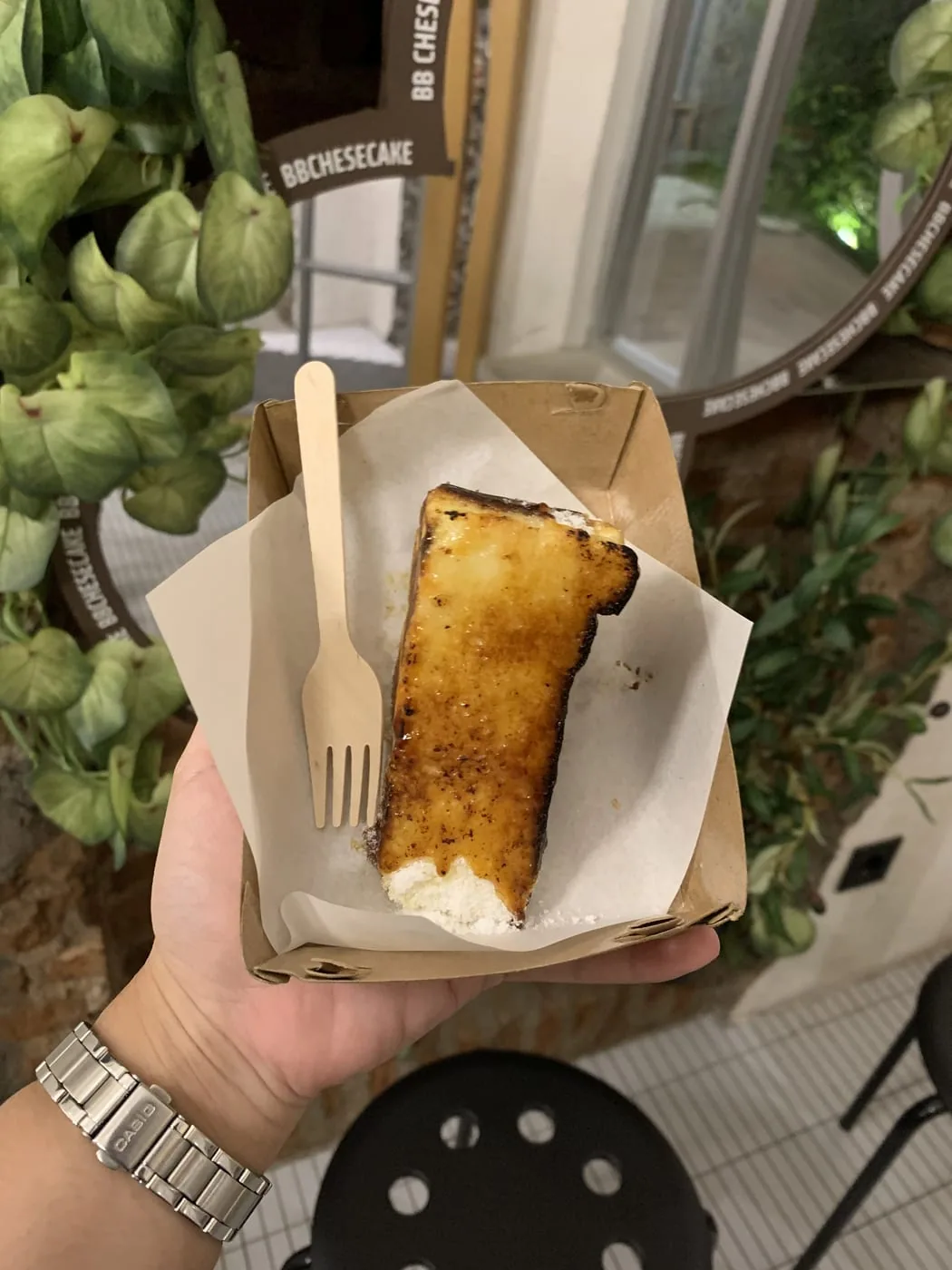
Basque Burnt Cheesecake
The San Sebastián cheesecake as Elena serves it: crustless, baked ferociously hot until the top is nearly black, with a center that stays just short of set. The burnt top is not a mistake — it is the flavor. All the work is in restraint: room-temperature ingredients, a gentle hand, and the patience to chill it properly.
mostly unattended — the clock does the work
From Fuego y Mar (2023)
by Elena Vidal✓ endorsed by the chef
Ingredients
for 12 pieces
- 900 gfull-fat cream cheese — block-style, at true room temperature
- 250 ggranulated sugar
- 6large eggs — at room temperature
- 480 mlheavy cream
or: crème fraîche · close match — A gentle tang and slightly more body — arguably even more Basque.
- 30 gall-purpose flour — sifted
- 0.5 tspfine sea salt
Equipment
checked against your kitchen
- ✓oven
A real 230°C oven; the char is non-negotiable.
- ✗stand mixeroptional
Anything that gets the batter perfectly smooth.
the compiler will re-target this step when the Compile Sheet lands
What 44 cooks learned
from real Cook Mode sessions — not reviews
Improved 1 time by 44 logged cooks of 874 verified.
- Finished it:
- 43 of 44
- Struggled:
- 1
- Reported success:
- 95% across 851 reports
Palate consensus
- 10 of 18 cooks who answered said too much sweetness — your palate profile is neutral here, so it compiles as written.
Every number here carries its denominator. Patterns below our sample floor are not shown at all — and only the strongest ones are allowed to change your compiled recipe.
Method
- 1
Take the cream cheese, eggs, and cream out of the fridge at least an hour ahead. Cold ingredients are why cheesecake batter goes lumpy — do not negotiate with this step.
1 h · 1 min attention - 2parallel track
Heat the oven to 230°C. Line a 23 cm springform with two overlapping sheets of parchment, pressed in so they rise a good 5 cm above the rim — the rustic pleats are part of the look.
15 min · 5 min attention230°C ambient - 3
waits for: step 1
Beat the cream cheese with the sugar on medium until completely smooth, scraping the bowl twice. Smooth now or lumpy forever.
4 min - 4
On low speed, add the eggs one at a time, waiting for each to disappear before the next. Stream in the cream with the salt, mixing only until combined — beating in air here means cracks later.
6 minskill: comfortableDone when: Batter runs off the spatula in a smooth, glossy ribbon with no fleck of unmixed cream cheese.
→ the custard
- 5
Sift the flour over the surface and fold it in with a spatula in as few strokes as it takes — the flour is insurance, not structure.
2 min - 6
waits for: steps 2 and 5
Pour the batter into the lined pan and rap it firmly on the counter three or four times to chase out the big bubbles.
3 min - 7
Bake at 230°C for about 50 minutes on a middle rack. Do not open the door before minute 40. You want a top the color of dark chestnut and a center that still moves.
50 min · 1 min attention230°C ambient⏱ Bake · 50 minDone when: Deeply burnished — nearly burnt — on top, set at the edges, and the middle jiggles like a set custard when you nudge the pan.
→ the custard
- 8
Cool in the pan on a rack to room temperature, about 90 minutes. It will sink dramatically in the middle as it cools. That collapse is correct.
1 h 30 min · 1 min attention⏱ Cool to room temperature · 1 h 30 min - 9
Chill, uncovered, for at least 4 hours — overnight is better. The texture you are after, dense at the rim melting to nearly liquid at the core, only happens in the fridge.
4 h · 1 min attention⏱ Chill · 4 h - 10
Lift the cheesecake out by the parchment, peel the sides down, and slice with a long knife dipped in hot water and wiped between cuts. Serve cool, never fridge-cold — 20 minutes on the counter first.
5 min
Why this grade?
- masters provenance+62
- validation: editor-verified+16
- 874 verified cooks+18
- 95% success across 851 reports+8.2
- Trust score100/100